Halifax doesn’t ask to be rushed.
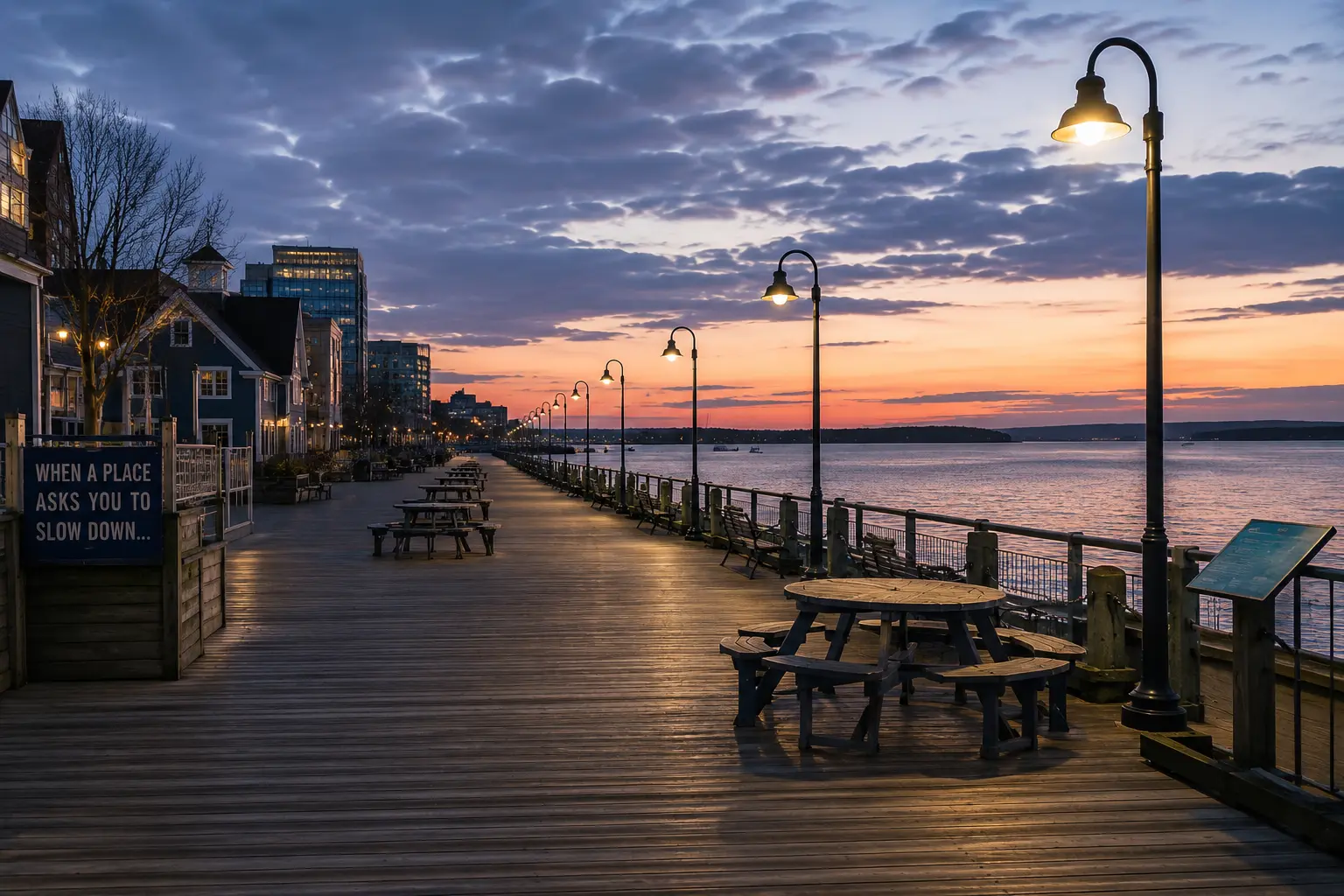
It unfolds in quieter layers — boardwalks stretching along the water, the repetition of footsteps against wood, the rhythm of ferries in the distance, and the steady presence of the harbour that seems to hold everything without demanding attention.
There is nothing urgent about it.
And yet, the longer you stay, the more it begins to shape how you move through it.
At first, most places are experienced quickly — a sequence of views, stops, and moments you think you are meant to capture. But Halifax resists that pace. It doesn’t reward urgency. It rewards attention.
The waterfront becomes less about movement and more about pause.
Benches face open water instead of landmarks.
Chairs sit angled toward distance rather than activity.
Even the fog feels less like weather and more like atmosphere — softening edges rather than hiding them.
And somewhere in that shift, something subtle happens.
You stop trying to see everything.
You start noticing what actually stays with you.
🌿 What changes when you slow down
What’s interesting about Halifax is that nothing about it demands performance from you.
It doesn’t compete for attention.
It doesn’t overwhelm you with choices.
It simply exists at its own pace and invites you to meet it there.
And when you do, your experience of it changes.
Small details begin to matter more than expected:
- the spacing between sounds on the water
- the rhythm of movement along the boardwalk
- the way distance feels more present than activity
It becomes less about what there is to do
and more about what you notice when you stop rushing through it.
That shift is subtle — but it changes everything.
🌊 A wider shift in how we travel
Travel is changing.
Not only in where people go, but in how they choose to experience those places.
There is a growing awareness that more movement does not always create more meaning — and that the most memorable parts of a journey are often not the busiest ones.
They are the quieter moments in between:
- sitting instead of moving
- observing instead of checking off
- noticing instead of consuming
Halifax reflects that shift without trying to define it.
It simply shows it.
🌿 How this shapes the way I approach travel
This is also where my own approach to travel planning begins.
Not with a list of places, but with an understanding of how someone wants to experience a place once they arrive.
Because two people can stand in the same destination and have completely different journeys depending on pace, intention, and the space they allow themselves to experience it in.
Some travellers want movement and energy.
Others want stillness and depth.
Most want something in between — but don’t always know how to shape that before they travel.
That is often where thoughtful planning matters most.
Not in choosing what to see —
but in shaping how it feels to move through it.
🌊 Closing reflection
Halifax, seen this way, is not just a destination.
It becomes a reminder that travel is not only about where you go — but how willing you are to let a place reveal itself to you.
And sometimes, the most meaningful journeys are not the ones that ask for more from you.
They are the ones that ask you to slow down enough to actually notice them.

 Charlene Joseph-Dunbar